


Research and education
Research
Research conducted alongside educational activities plays a pivotal role in advancing the understanding, diagnosis and management of lipid disorders. Research should be prioritized in most lipid clinics, and medical time should be dedicated to clinical and translational research particularly in tier 3 and 4 lipid clinics (Figure 5), which may benefit from coordination at a national level. Furthermore, scientific staff including nurses and sub-investigators are needed to take part in clinical trials investigating new pharmaceutical drugs in lipid clinics. Patient registration in registries for rare lipid disorders must also be prioritized. Integrating research into clinical practice fosters continuous improvement through education and may contribute to the effort to reduce ASCVD and other lipid-related disorders in patients with hyperlipidaemia. The development of new treatments like PCSK9 inhibitors, apo C3 inhibitors, and ANGPTL3 inhibitors have been made possible by translational research on rare lipid disorders in lipid clinics.
Education
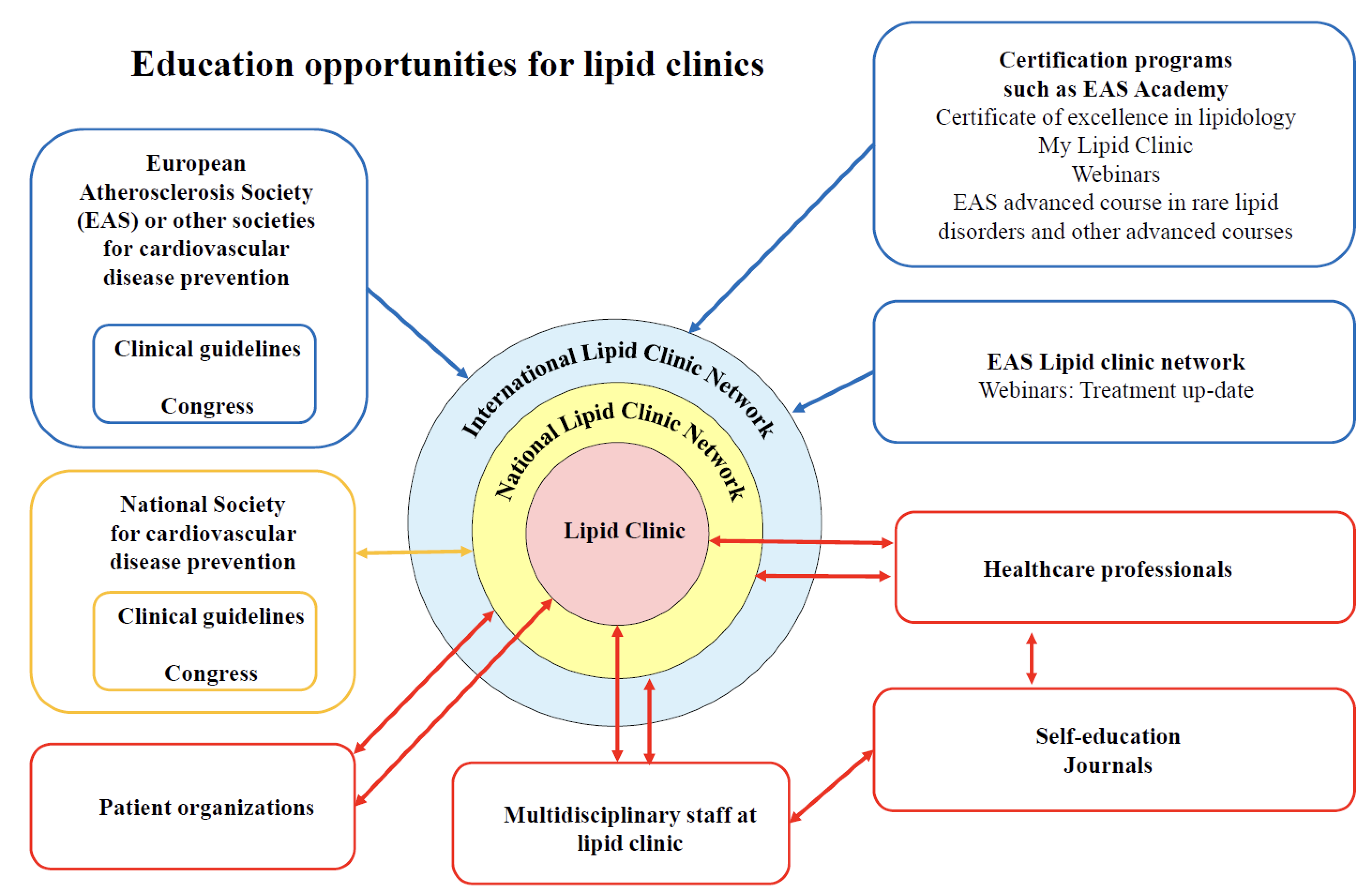
Continuous education for staff at lipid clinics, other healthcare professionals and patients is essential for achieving optimal patient care. Here, we aim to propose standards for education in lipid clinics and to outline how the EAS, other international organizations, and national or local initiatives can contribute to achieve these standards (Figure 10). Lipid clinics are encouraged to engage in a strong educational network with healthcare professionals managing patients with hyperlipidaemia. Regular participation in organized continuing education or self-directed learning, such as reading scientific journals on cardiovascular disease prevention and clinical lipidology, represent valuable ways to stay informed about recent developments. Finally, we outline how patient education can be improved ideally involving patient organizations and caregivers.
Educational standards of lipid clinics
To ensure the best care for patients with lipid disorders, lipid clinics should foster a supportive and educational environment for their staff. A lipid clinic team typically includes several healthcare professional groups, such as nurses, physicians, genetic field workers, dietitians, physical activity specialists and administrative staff, each bringing their own expertise in treating and caring for patients. Educational programs should bring all these professional groups together to promote effective teamwork, potentially in collaboration with patient organizations. Several approaches can be implemented at local, national, and international levels within each lipid clinic.
Local educational initiatives
- Organize regular meetings, e.g. monthly or every two months, at which staff can receive updates on new research, treatment guidelines, and share practical clinical experiences
- Organize regular case discussions focusing on interesting or challenging patient cases. These discussions help develop clinical judgment, strengthen team collaboration, and facilitate shared learning among staff
- Provide mentorship programmes in which experienced colleagues support and guide those who are less experienced, which can help build confidence and ensure that everyone feels well prepared to manage the varying treatment needs of patients referred to the lipid clinic
- Organize journal clubs, where staff collectively read and discuss current scientific literature. This helps keep everyone updated on the latest research results while promoting a culture of continuous professional development
National educational initiatives
Participation in national meetings offers several benefits, including:
- Sharing the latest research findings and clinical guidelines
- Creating a clinical network across the country that can be utilized for example in situations involving cascade screening of families living in different parts of the country
- Fostering the development of common guidelines and patient materials, ideally in collaboration with patients or patient organizations
National lipid clinic networks can also support collaborative research projects.
International educational initiatives
Finally, participation in international cardiovascular prevention and lipid meetings and workshops can strengthen knowledge and community worldwide. For rare lipid disorders, sharing experiences and knowledge with international colleagues can be particularly beneficial and enable the establishment of larger research communities.
International organisations such as the European Atherosclerosis Society (EAS) provide important resources, including:
- Webinars at national (in local or regional language) and international levels make it easy to access expert knowledge and stay updated without traveling. Examples include EAS webinars by country in local language, EAS webinars in English for all, EAS practical clinical cases in “Your lipid clinic for today”
- Certification programs through the EAS portal provide opportunities for formal education and documented expertise in lipidology. Examples include the EAS Certificate of Excellence for Clinicians and the EAS Certificate in Lipidology for Health Care Professionals
- Support for attending courses and congresses, which provide opportunities to meet other professionals, learn about new research, and find inspiration for clinical practice. Most of the talks presented at the EAS congress are available on the EAS academy website, like EAS Course on Rare Dyslipidaemias and EAS congresses
Educational network with health care professionals organized by local lipid clinics
Lipid clinics should provide courses and continuing medical education targeted at general practitioners/family doctors, paediatricians, endocrinologists, cardiologists, nurses, dietitians and other relevant specialists in their region or in the whole country jointly with relevant national societies. Here are some examples of educational initiatives that can be very effective:
- The establishment of a dedicated hotline to consult a physician of the lipid clinic regarding any clinical uncertainties
- Regular interdisciplinary meetings with healthcare professionals who refer and manage patients with dyslipidemia to foster strong cooperation and improve patient outcomes
- Organizing training sessions on lipidology, treatment guidelines, and referral criteria
Patient organizations
Patient organisations and ambassador programmes provide peer support, advocacy, and education, allowing patients to learn from others with similar experiences. Personal narratives are especially valuable for patients who feel uncertain about treatment or want insight beyond the clinical perspective. Clinics should actively collaborate with patient organisations to strengthen engagement and extend support beyond clinical settings. The EAS Lipid Clinic Network promotes collaboration between clinics and patient groups (e.g. FH Europe Foundation) to standardise care and amplify patient voices. The European Patients’ Forum similarly highlights the role of patient organisations in shaping health policy and providing peer-led support.