


Definition of a lipid clinic and harmonization of what the clinics provide
Definition
A lipid clinic is a healthcare unit specialized in diagnostics, treatment and management of patients with lipid disorders that combines clinical expertise, patient-centered care and evidence-based medicine to prevent development of ASCVD, acute pancreatitis and other lipid-related diseases (Figure 5).
We propose to categorise lipid clinics (albeit arbitrarily) into four types of lipid clinics according to increasing specialization and resources allocated (tier 1 through 4). Children with confirmed or suspected inherited lipid disorders should be managed in secondary or tertiary lipid clinics by (or in close collaboration with) specialized paediatricians or in family lipid clinics.
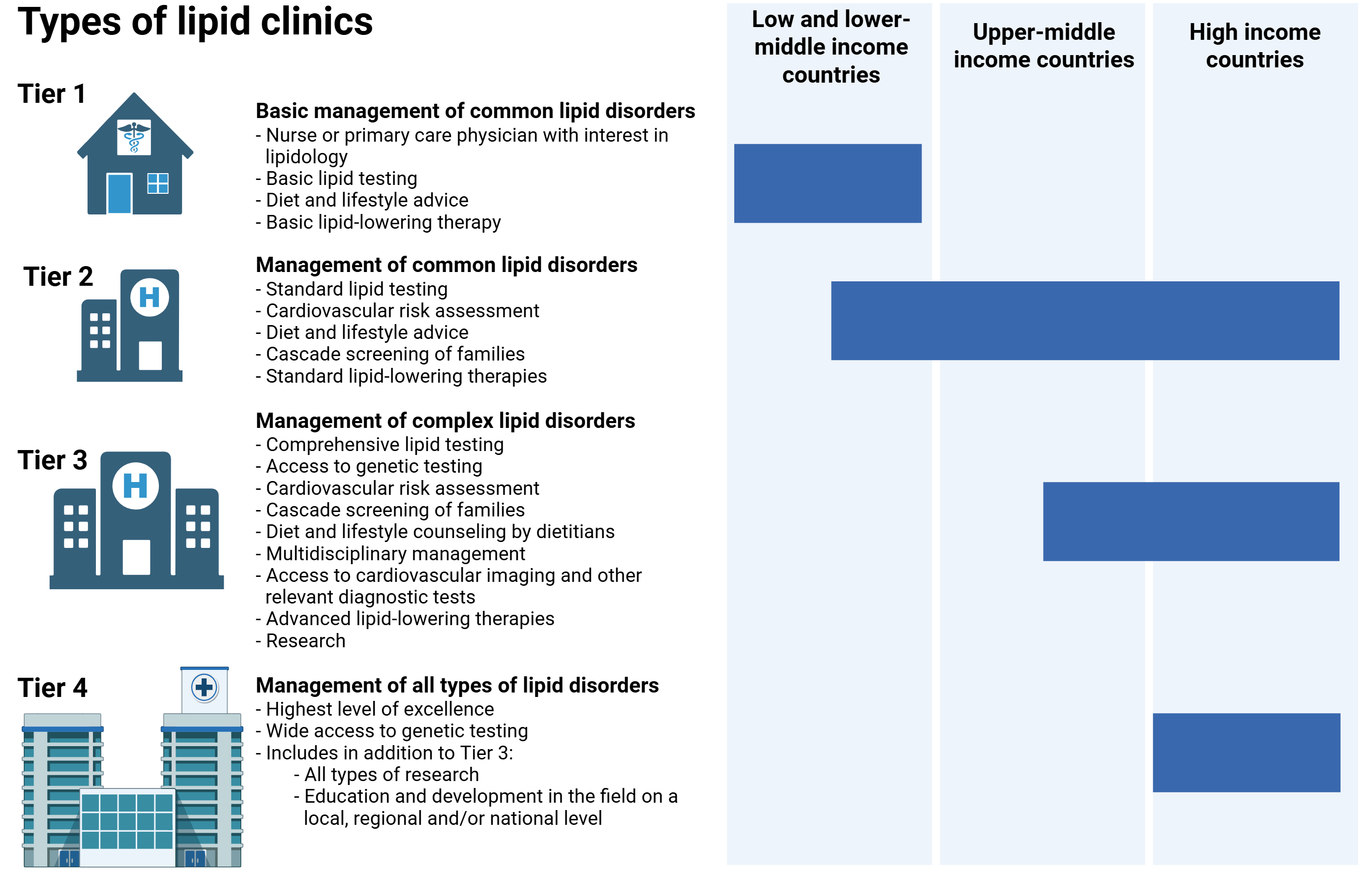
| Tier 1 | Tier 1 lipid clinics represent satellite healthcare units located in remote geographical areas in low and lower-middle income countries. These lipid clinics should have the capacity to conduct basic lipid testing such as total cholesterol and triglycerides, provide standard diet and lifestyle advice, and to initiate and provide basic lipid-lowering therapies such as statins. |
| Tier 2 | Tier 2 lipid clinics should have the capacity to facilitate standard full lipid profile testing for diagnosis of common lipid disorders, and to perform cardiovascular risk assessment, cascade screening of families, and to give diet and lifestyle counselling. Also, treatment with traditional lipid-lowering therapies like statins and ezetimibe should be carried out in these lipid clinics, while complex lipid disorders can be referred to tier 3 and 4 lipid clinics. |
| Tier 3 | Tier 3 lipid clinics additionally have the capacity to perform comprehensive lipid tests, including access to genetic testing for lipid disorders. They also have resources to provide multidisciplinary management of more complex and inherited lipid disorders, including cascade screening of families and access to more advanced lipid-lowering therapies. Moreover, tier 3 lipid clinics should have access to cardiovascular imaging and other relevant diagnostic tests and resources to participate in research. |
| Tier 4 | Tier 4 lipid clinics represent the highest level of excellence for managing complex, rare, or severe lipid disorders. Further, such clinics in addition have the capacity to contribute to all types of research, education and development on regional, national and/or international levels. |
The proposed definition of and categorisation of tier 1 to 4 lipid clinics are based on expert opinion. It can be argued that core multidisciplinary models of tier 2 to 4 lipid clinics are biased towards Western, high-income healthcare infrastructures. Therefore, the guidance provided for low- and lower-middle-income countries may lack the practical adaptations required for constrained healthcare systems, which needs to be developed further in such countries in the future.
Harmonization
Key to the success of lipid clinics in individual countries and worldwide is harmonization of what these clinics provide, such that patients and referring physicians know what service to expect. Optimal utilization of resources in lipid clinics relies on ensuring that the right patients are referred for specialized care, and that high quality care in the lipid clinics is maintained. This may be facilitated by harmonization of lipid clinic definition, staffing and multidisciplinary care, criteria for referral, lipoprotein(a) testing, genetic testing, diagnostic criteria, patient information, the possibility of involvement in research and education, monitoring quality, lipid profile offered, treatment options and funding of lipid clinics.
Harmonization should always be possible within each country; however, some aspects vary markedly by country income level, meaning that full international harmonization of all lipid clinic topics may not always be feasible . These topics are described further in the text. The proposed recommendations are based on expert opinion, partly informed by successful implementation in several European countries.
- Staff
- Referral criteria
- Lipid profile
- Genetic testing
- Subclinical atherosclerosis and imaging
- Diagnostic criteria and coding
- Treatment (see next tab)
Staffing of lipid clinics
A multidisciplinary approach within lipid clinics is essential for optimal management and shared decision-making in patients with severe lipid disorders and their families. From referral through diagnosis, treatment, and follow-up, such collaboration improves adherence to lifestyle changes and medication, thereby improving long-term outcomes.
National collaboration between lipid clinics is also important to improve cascade screening and raise overall knowledge. A multidisciplinary approach supports accurate diagnosis through integrated clinical and genetic assessment, optimises treatment strategies combining pharmacological and lifestyle interventions, and enhances patient adherence.
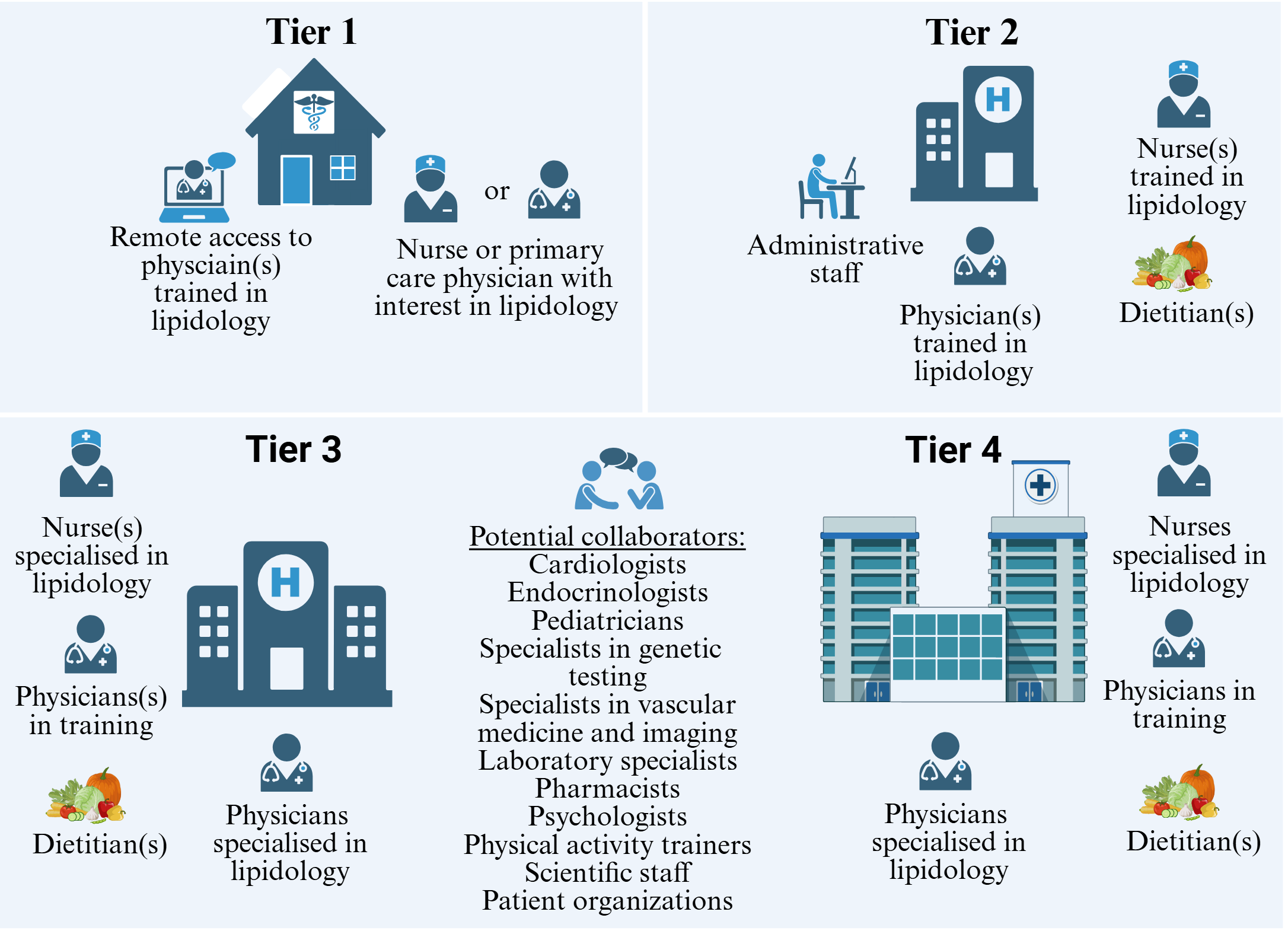
Staffing varies by the type of clinic. Tier 1 clinics in remote areas may include a nurse or primary care physician with an interest in lipidology, while tier 2–4 clinics are run by specialists in lipidology (Figure 6). These higher-tier clinics also include nurses and dietitians/nutritionists, with administrative staff supporting coordination. Tier 3 and especially tier 4 clinics rely on close collaboration with additional specialists.
Physicians are responsible for referral assessment, diagnosis, risk stratification, treatment initiation, and genetic counselling, as well as education of staff. Nurses support family history collection, cascade screening, and patient follow-up. Dietitians provide core dietary and lifestyle counselling. Management of children with FH requires specialist expertise and should be carried out in dedicated paediatric or family lipid clinics, or in collaboration with paediatricians.
Referral criteria
National criteria for referral to lipid clinics are important to identify patients who benefit from specialised care. Optimal use of resources requires that secondary causes of dyslipidaemia are ruled out before referral (e.g. hypothyroidism, poorly controlled diabetes mellitus, nephrotic syndrome, chronic renal failure, primary biliary cholangitis, drug-induced dyslipidaemia, or extreme diets).
The following types of patients should then be referred to lipid clinics:
- Suspected familial hypercholesterolemia (FH)
- Adults with LDL cholesterol ≥5.0 mmol/L (≥ 190 mg/dL)6. Total cholesterol ≥7.5 mmol/L (≥ 290 mg/dL) may be used if LDL cholesterol is not available
- LDL cholesterol ≥4.0 mmol/L (>155mg/dL) in patients with early onset ASCVD (men <55 years, women <60 years), tendon xanthomas, or a strong family history of ASCVD6
- Children and individuals below 40 years of age with LDL cholesterol ≥4.0 mmol/L (≥155 mg/dL)6
- First-degree relatives (biological parent, sibling or child) to patients diagnosed with FH
- Homozygous FH at any age as per EAS diagnostic criteria 7, 8
- Severe hypertriglyceridaemia ≥10 mmol/L (880 mg/dL) or likely hypertriglyceridemia-induced pancreatitis in patients with moderate to severe triglyceride elevations. Persistent triglycerides ≥5.6 mmol/L (500 mg/dL) despite diet and lifestyle intervention and optimal management of secondary causes of hypertriglyceridaemia
- Very high lipoprotein(a) >200 nmol/L (95 mg/dL) (recommended as single lifetime test) or progressive or early onset ASCVD in patients with high lipoprotein(a) 9, 10.
- Premature or progressive ASCVD despite guideline-directed lipid-lowering therapy, where combination therapy (high-intensity statin + ezetimibe + bempedoic acid) and consideration of advanced lipid lowering therapies (e.g. + PCSK9 inhibitors) is needed or treatment targets remain unmet 11
- Residual risk in patients with optimized LDL cholesterol and recurrent ASCVD
- Statin intolerance (inability to tolerate ≥2 different statins, including at lowest doses) with unmet LDL cholesterol targets to evaluate alternative lipid-lowering therapy 12
- Complex or rare hyper- and hypolipidaemias like familial remnant hyperlipidaemia (= dysbetalipoproteinaemia), mixed hyperlipidaemia, sitosterolaemia, chylomicronaemia syndromes, and hypobetalipoproteinaemia 13
- Pregnancy / pre-conception counselling in patients with FH or familial chylomicronaemia syndrome
- Paediatric hyperlipidaemia, especially suspected FH or severe hypertriglyceridaemia for family-based care and cascade screening in families
- Complicated forms of secondary hyperlipidaemia requiring specialist care such as patients with primary biliary cholangitis, human immunodeficiency virus, systemic lupus erythematosus and some endocrine disorders (e.g. partial lipodystrophy)
Elevated LDL cholesterol and triglycerides that exceeds the specified cut-offs mentioned above should be confirmed by at least two measurements before referral, either in the non-fasting or fasting state. Furthermore, it should be stressed that the recommended criteria for referral do not constitute a complete list but highlight the most important indications for referral to lipid clinics.
Lipid profile
Upon referral to a lipid clinic, the first goal is to make the correct diagnosis for each individual patient. This can only be achieved if the optimal diagnostic tests are available in lipid clinics (Figure 7).
| Dagnostic tests | Low- and lower-middle income countries | Upper-middle income countries | High-income countries |
| Simple screening testsª Total cholesterol (TC), triglycerides (TG) | Available | Standard lipid profile + lipoprotein(a) preferred | Standard lipid profile + lipoprotein(a) preferred |
| Standard lipid profile TC, HDL-C, TG, LDL-C, remnant-Cb | Mostly available | Available | Universally available |
| Screening for secondary hyperlipidaemia TSH, eGFR, glucose, ALT, AST, GGT, urinary protein (AUCR) | Mostly available | Available | Universally available |
| Lipoprotein(a) | Limited access | Availablec | Availablec |
| Additional lipid tests ApoB, directly measured LDL-C | Limited access | Availablec | Availablec |
| Genetic testing Screening for FH, diagnosis of rare genetic hyper- and hypolipidaemias | No access | Limited access | Restriced access |
ALT=alanine aminotransferase; apoB=apolipoprotein B; AUCR=albumin/creatinine ratio in urine sample; AST=aspartate aminotransferase; eGFR= estimated glomerular filtration rate; FH=familial hypercholesterolemia; GGT=gamma glutamyltransferase; HDL-C=high-density lipoprotein cholesterol; LDL-C=low-density lipoprotein cholesterol; Lp(a)=lipoprotein(a); TC=total cholesterol; TG=triglycerides; TSH=thyroid stimulating hormone;
a Intended for very inexpensive recognition of serious elevations of cholesterol/triglycerides
b Any diagnostic laboratory can calculate and report free of charge these values from the standard lipid profile
c Lp(a) measurement might be restricted, direct LDL cholesterol assays can be replaced by e.g. Martin-Hopkins15 or Sampson-NIH equations 16, 17
Standard lipid profile
All patients should preferably be referred to the lipid clinic with a standard lipid profile already measured, including total cholesterol, triglycerides, HDL cholesterol, LDL cholesterol, remnant cholesterol, and non-HDL cholesterol. LDL cholesterol can be calculated using established equations (e.g. Friedewald14, Martin-Hopkins15, or Sampson-NIH16, 17) or measured directly; whether calculated or measured LDL cholesterol are superior and less prone to error with high triglyceride levels is unclear18,19.
Non-HDL-cholesterol and remnant cholesterol levels should be calculated in all patients because non-HDL cholesterol outperforms total and LDL cholesterol in ASCVD risk stratification and better reflects actual ASCVD risk20, while elevated remnant cholesterol captures the residual risk of ASCVD when triglycerides are elevated after LDL cholesterol therapy21. Non-HDL cholesterol is total cholesterol minus HDL cholesterol, and remnant cholesterol is total cholesterol minus LDL cholesterol minus HDL cholesterol.
Fasting is not routinely required for screening22, and most guidelines no longer recommend repeat fasting lipid profiles even when triglycerides are elevated23.
Lipoprotein(a)
Lipoprotein(a) levels should be measured at least once in all individuals3,11, either at the first lipid profile or the next available one3, 4, 9, 11, 24, 25. Re-measurement may be relevant if Lp(a)-lowering therapy is initiated, after menopause in women, and one month after acute coronary syndrome or ischemic stroke11, 24.
Plasma lipoprotein(a) levels are >90% genetically determined, and more than 20% of individuals have levels above 105 nmol/L (50 mg/dL), a causal risk factor for ASCVD and aortic stenosis 9, 24. High Lp(a) may contribute to LDL cholesterol levels and explains up to one quarter of clinical FH diagnoses26, 27. Measurement should be available in all lipid clinics for assessment of hypercholesterolemia, cardiovascular risk stratification, and identification of individuals with increased genetic risk of ASCVD11, 28. Lp(a) should be measured in fresh blood using assays largely independent of apo(a) isoform size24, with preference for nmol/L over mg/dL, although mg/dL is acceptable if nmol/L is not available24.
Apolipoprotein B and high-sensitivity C-reactive protein
Because apolipoprotein B (apoB) concentration is a better predictor of risk for future ASCVD events than LDL cholesterol, apoB assessment should ideally be available in laboratories serving lipid clinics29. In contrast to LDL cholesterol, both apoB and non-HDL cholesterol remain predictive of ASCVD risk even in statin-treated patients30-33. ApoB may be the most reliable proxy across LDL and non-HDL cholesterol concentrations34, although it is still unclear whether apoB or non-HDL cholesterol is consistently superior.
High-sensitivity C-reactive protein also provides additional predictive value, and persistently elevated levels >2 mg/L identify patients at increased ASCVD risk21.
Screening for causes of secondary lipid disorders
Initial assessment of hyperlipidaemia must exclude the most common secondary causes of lipid disorders. The biochemical screening shall include evaluation of:
- Thyroid-stimulating hormone (TSH) to exclude hypothyroidism
- Liver function tests (transaminases, gamma glutamyltransferase and alkaline phosphatase) to exclude liver impairment
- HbA1c or fasting glucose to exclude diabetes mellitus
- Estimated glomerular filtration rate (eGFR) to exclude impaired renal function and proteinuria to screen for nephrotic syndrome
Assessment of potential causes of secondary dyslipidaemia or aggravating factors of hyperlipidaemia should also comprise careful pharmacological and personal history and other examinations like body weight, waist circumference and dietary assessment.
Genetic testing
Shared decision-making and informed consent between patient and healthcare provider are essential, as patient values and preferences play a key role35. Genetic testing is generally recommended when monogenic hyperlipidaemias (e.g. FH, familial chylomicronaemia syndrome, familial remnant hyperlipidaemia) or rare lipid disorders (e.g. lysosomal acid lipase deficiency, sitosterolemia) are suspected13. Other indications for genetic testing include rare lipoprotein phenotypes with low lipid levels (e.g. hypo- and abetalipoproteinemia, severe hypoalphalipoproteinaemia)13.
Strict adherence to guidelines for reporting genetic test results reporting must be ensured36, 37. Interpretation can be challenging, as variants of unknown significance (VUS) or novel variants are often detected.
Subclinical atherosclerosis and imaging
In asymptomatic apparently healthy individuals, imaging to detect subclinical atherosclerosis can be important. The presence of an unequivocal atherosclerotic lesion in any vascular bed indicates increased ASCVD risk independent of other risk factors3, 11. Although evidence is stronger for CAC, carotid or femoral plaques (not intima-media thickness) on ultrasound may also reclassify risk and can be considered in intermediate-risk patients and young adults20.
Increased coronary artery calcium (CAC) is a risk modifier in individuals at moderate risk or near treatment thresholds11. The ankle-brachial index can also indicate peripheral arterial disease, with values <0.9 associated with increased ASCVD risk in individuals without diabetes mellitus20.
Coronary CT angiography (CCTA) is another method to visualise coronary atherosclerosis38 and can detect non-calcified plaques, but its value compared with CAC in risk stratification remains uncertain, as it has mainly been studied in symptomatic patients. It may be appropriate in selected individuals aged <45–50 years with risk factors such as diabetes, HIV, smoking, or strong family history of premature ASCVD39. Other high-risk groups include patients with FH and inflammatory diseases such as SLE, rheumatoid arthritis, or psoriasis.
Diagnostic criteria and coding
The diagnostic procedures of the aetiology of hyperlipidaemia should include a detailed medical history and physical examination. The following criteria are recommended for the diagnosis of primary hyperlipidaemias:
- Familial hypercholesterolemia:
The Dutch Lipid Network (DLCN) diagnostic criteria are one of the most widely used scoring systems for FH in adults40. In addition to plasma LDL cholesterol levels, it also includes information on first-degree relatives with premature ASCVD or elevated LDL cholesterol, clinical history of premature ASCVD, FH stigmata such as tendon xanthomas or arcus cornealis, and detection of pathogenic variants in genes causing FH. According to scores obtained, patients can be divided into those with definite (>8 points), probable (6-8 points), possible (3-5 points) or unlikely (<3 points) FH by the DLCN criteria. However, the DLCN diagnostic criteria are not applicable for children in whom the Simon Broome criteria and/or FH Paediatric Diagnostic Score (FH-PeDS)41 are options. Genetic testing should be considered in all individuals suspected of having FH. A clinical diagnosis of FH may be established based on a DLCN score ≥ 6. - Familial remnant hyperlipidaemia (=dysbetalipoproteinaemia):
The combination of both increased plasma triglycerides above 5 mmol/L (440 mg/dL) and total cholesterol above 8 mmol/L (300 mg/dL) with a concomitant moderate to low apoB concentration (< 1g/l) is compatible with the diagnosis. Some criteria use cholesterol enrichment of apoB containing lipoproteins42; however, these criteria are not standardized. An APOE genotype should be requested, where APOE E2/E2 genotype and some rare deleterious variants with dominant inheritance makes the diagnosis likely. - Chylomicronaemia:
A plasma triglycerides concentration above 10 mmol/L (880 mg/dL) is diagnostic. The criteria proposed by Moulin and coworkers are suggested to distinguish between a monogenic and multifactorial aetiology43. Alternatively, the North American Familial Chylomicronaemia Syndrome score may used44. - Rare lipid disorders:
Lysosomal acid lipase deficiency, sitosterolaemia, familial chylomicronaemia syndrome and hypo-/abetalipoproteinnaemia should be diagnosed based on genetic testing. ApoB measurement naturally is also necessary for diagnosing hypo- and abetalipoproteinaemia.
Standardization of diagnostic coding should be performed at national levels and validation of disease registries is important to ensure the validity of the registered diagnoses. The World Health Organisation (WHO) International Classification of Diseases (ICD) codes are the recommended option.
3. Mach F, Baigent C, Catapano AL, Koskinas KC, Casula M, Badimon L, et al. 2019 ESC/EAS Guidelines for the management of dyslipidaemias: lipid modification to reduce cardiovascular risk. Eur Heart J. 2020;41(1):111–88.
4. Mach F, Koskinas KC, Roeters van Lennep JE, Tokgozoglu L, Badimon L, Baigent C, et al. 2025 Focused Update of the 2019 ESC/EAS Guidelines for the management of dyslipidaemias. Atherosclerosis. 2025;409:120479.
6. Hedegaard BS, Bork CS, Kanstrup HL, Thomsen KK, Heitmann M, Bang LE, et al. Genetic testing increases the likelihood of a diagnosis of familial hypercholesterolaemia among people referred to lipid clinics: Danish national study. Atherosclerosis. 2023;373:10–6.
7. Wiegman A, Gidding SS, Watts GF, Chapman MJ, Ginsberg HN, Cuchel M, et al. Familial hypercholesterolaemia in children and adolescents: gaining decades of life by optimizing detection and treatment. Eur Heart J. 2015;36(36):2425–37.
8. Cuchel M, Bruckert E, Ginsberg HN, Raal FJ, Santos RD, Hegele RA, et al. Homozygous familial hypercholesterolaemia: new insights and guidance for clinicians to improve detection and clinical management. A position paper from the Consensus Panel on Familial Hypercholesterolaemia of the European Atherosclerosis Society. Eur Heart J. 2014;35(32):2146–57.
9. Kronenberg F, Mora S, Stroes ESG, Ference BA, Arsenault BJ, Berglund L, et al. Lipoprotein(a) in atherosclerotic cardiovascular disease and aortic stenosis: a European Atherosclerosis Society consensus statement. Eur Heart J. 2022;43(39):3925–46.
10. Hedegaard BS, Bork CS, Kaltoft M, Klausen IC, Schmidt EB, Kamstrup PR, et al. Equivalent Impact of Elevated Lipoprotein(a) and Familial Hypercholesterolemia in Patients With Atherosclerotic Cardiovascular Disease. J Am Coll Cardiol. 2022;80(21):1998–2010.
11. Mach F, Koskinas KC, Roeters van Lennep JE, Tokgozoglu L, Badimon L, Baigent C, et al. 2025 Focused Update of the 2019 ESC/EAS Guidelines for the management of dyslipidaemias. Eur Heart J. 2025;46(42):4359–78.
12. Stroes ES, Thompson PD, Corsini A, Vladutiu GD, Raal FJ, Ray KK, et al. Statin-associated muscle symptoms: impact on statin therapy-European Atherosclerosis Society Consensus Panel Statement on Assessment, Aetiology and Management. Eur Heart J. 2015;36(17):1012–22.
13. Hegele RA, Boren J, Ginsberg HN, Arca M, Averna M, Binder CJ, et al. Rare dyslipidaemias, from phenotype to genotype to management: a European Atherosclerosis Society task force consensus statement. Lancet Diabetes Endocrinol. 2020;8(1):50–67.
14. Friedewald WL, RI, DS F. Estimation of the concentration of low-density lipoprotein cholesterol in plasma, without use of the preparative ultracentrifuge. Clin Chem. 1972;18(6):499–502.
15. Martin SS, Blaha MJ, Elshazly MB, Toth PP, Kwiterovich PO, Blumenthal RS, et al. Comparison of a novel method vs the Friedewald equation for estimating low-density lipoprotein cholesterol levels from the standard lipid profile. JAMA. 2013;310(19):2061–8.
16. Sampson M, Ling C, Sun Q, Harb R, Ashmaig M, Warnick R, et al. A New Equation for Calculation of Low-Density Lipoprotein Cholesterol in Patients With Normolipidemia and/or Hypertriglyceridemia. JAMA Cardiol. 2020;5(5):540–8.
17. Sampson M, Zubiran R, Wolska A, Meeusen JW, Donato LJ, Jaffe AS, et al. A Modified Sampson-NIH Equation with Improved Accuracy for Estimating Low Levels of Low-Density Lipoprotein-Cholesterol. Clin Chem. 2025;71(11):1125–37.
18. Islam SMT, Osa-Andrews B, Jones PM, Muthukumar AR, Hashim I, Cao J. Methods of Low-Density Lipoprotein-Cholesterol Measurement: Analytical and Clinical Applications. EJIFCC. 2022;33(4):282–94.
19. Langlois MR, Nordestgaard BG, Langsted A, Chapman MJ, Aakre KM, Baum H, et al. Quantifying atherogenic lipoproteins for lipid-lowering strategies: consensus-based recommendations from EAS and EFLM. Clin Chem Lab Med. 2020;58(4):496–517.
20. Visseren FLJ, Mach F, Smulders YM, Carballo D, Koskinas KC, Back M, et al. 2021 ESC Guidelines on cardiovascular disease prevention in clinical practice. Eur Heart J. 2021;42(34):3227–337.
21. Wulff AB, Nordestgaard BG. Residual cardiovascular risk beyond low-density lipoprotein cholesterol: inflammation, remnant cholesterol, and lipoprotein(a). Eur Heart J. 2025;46(32):3178–80.
22. Nordestgaard BG, Langsted A, Mora S, Kolovou G, Baum H, Bruckert E, et al. Fasting is not routinely required for determination of a lipid profile: clinical and laboratory implications including flagging at desirable concentration cut-points-a joint consensus statement from the European Atherosclerosis Society and European Federation of Clinical Chemistry and Laboratory Medicine. Eur Heart J. 2016;37(25):1944–58.
23. Langsted A, Nordestgaard BG. Worldwide Increasing Use of Nonfasting Rather Than Fasting Lipid Profiles. Clin Chem. 2024;70(7):911–33.
24. Nordestgaard BG, Langsted A. Lipoprotein(a) and cardiovascular disease. Lancet. 2024;404(10459):1255–64.
25. Pearson GJ, Thanassoulis G, Anderson TJ, Barry AR, Couture P, Dayan N, et al. 2021 Canadian Cardiovascular Society Guidelines for the Management of Dyslipidemia for the Prevention of Cardiovascular Disease in Adults. Can J Cardiol. 2021;37(8):1129–50.
26. Hedegaard BS, Nordestgaard BG, Kanstrup HL, Thomsen KK, Bech J, Bang LE, et al. High Lipoprotein(a) May Explain One-Quarter of Clinical Familial Hypercholesterolemia Diagnoses in Danish Lipid Clinics. J Clin Endocrinol Metab. 2024;109(3):659–67.
27. Langsted A, Kamstrup PR, Benn M, Tybjaerg-Hansen A, Nordestgaard BG. High lipoprotein(a) as a possible cause of clinical familial hypercholesterolaemia: a prospective cohort study. Lancet Diabetes Endocrinol. 2016;4(7):577–87.
28. Cuchel M, Raal FJ, Hegele RA, Al-Rasadi K, Arca M, Averna M, et al. 2023 Update on European Atherosclerosis Society Consensus Statement on Homozygous Familial Hypercholesterolaemia: new treatments and clinical guidance. Eur Heart J. 2023;44(25):2277–91.
29. Nordestgaard BG, Langlois MR, Langsted A, Chapman MJ, Aakre KM, Baum H, et al. Quantifying atherogenic lipoproteins for lipid-lowering strategies: Consensus-based recommendations from EAS and EFLM. Atherosclerosis. 2020;294:46–61.
30. Ference BA, Ginsberg HN, Graham I, Ray KK, Packard CJ, Bruckert E, et al. Low-density lipoproteins cause atherosclerotic cardiovascular disease. 1. Evidence from genetic, epidemiologic, and clinical studies. A consensus statement from the European Atherosclerosis Society Consensus Panel. Eur Heart J. 2017;38(32):2459–72.
31. Johannesen CDL, Mortensen MB, Langsted A, Nordestgaard BG. Apolipoprotein B and Non-HDL Cholesterol Better Reflect Residual Risk Than LDL Cholesterol in Statin-Treated Patients. J Am Coll Cardiol. 2021;77(11):1439–50.
32. Marston NA, Giugliano RP, Melloni GEM, Park JG, Morrill V, Blazing MA, et al. Association of Apolipoprotein B-Containing Lipoproteins and Risk of Myocardial Infarction in Individuals With and Without Atherosclerosis: Distinguishing Between Particle Concentration, Type, and Content. JAMA Cardiol. 2022;7(3):250–6.
33. Li TY, Zhu P, Song Y, Tang XF, Gao Z, Gao RL, et al. Discordance analysis for apolipoprotein and lipid measures for predicting myocardial infarction in statin-treated patients with coronary artery disease: a cohort study. J Geriatr Cardiol. 2023;20(12):845–54.
34. Sniderman AD, Dufresne L, Pencina KM, Bilgic S, Thanassoulis G, Pencina MJ. Discordance among apoB, non-high-density lipoprotein cholesterol, and triglycerides: implications for cardiovascular prevention. Eur Heart J. 2024;45(27):2410–8.
35. Brown EE, Sturm AC, Cuchel M, Braun LT, Duell PB, Underberg JA, et al. Genetic testing in dyslipidemia: A scientific statement from the National Lipid Association. J Clin Lipidol. 2020;14(4):398–413.
36. Chora JR, Iacocca MA, Tichy L, Wand H, Kurtz CL, Zimmermann H, et al. The Clinical Genome Resource (ClinGen) Familial Hypercholesterolemia Variant Curation Expert Panel consensus guidelines for LDLR variant classification. Genet Med. 2022;24(2):293–306.
37. Deans ZC, Ahn JW, Carreira IM, Dequeker E, Henderson M, Lovrecic L, et al. Recommendations for reporting results of diagnostic genomic testing. Eur J Hum Genet. 2022;30(9):1011–6.
38. Fuchs A, Kuhl JT, Sigvardsen PE, Afzal S, Knudsen AD, Moller MB, et al. Subclinical Coronary Atherosclerosis and Risk for Myocardial Infarction in a Danish Cohort : A Prospective Observational Cohort Study. Ann Intern Med. 2023;176(4):433–42.
39. Narula J, Chandrashekhar Y, Ahmadi A, Abbara S, Berman DS, Blankstein R, et al. SCCT 2021 Expert Consensus Document on Coronary Computed Tomographic Angiography: A Report of the Society of Cardiovascular Computed Tomography. J Cardiovasc Comput Tomogr. 2021;15(3):192–217.
40. Nordestgaard BG, Chapman MJ, Humphries SE, Ginsberg HN, Masana L, Descamps OS, et al. Familial hypercholesterolaemia is underdiagnosed and undertreated in the general population: guidance for clinicians to prevent coronary heart disease: consensus statement of the European Atherosclerosis Society. Eur Heart J. 2013;34(45):3478–90a.
41. Kafol J, Miranda B, Sikonja R, Sikonja J, Wiegman A, Medeiros AM, et al. Proposal of a Familial Hypercholesterolemia Pediatric Diagnostic Score (FH-PeDS). Eur J Prev Cardiol. 2025.
42. Paquette M, Trinder M, Guay SP, Brunham LR, Baass A. Prevalence of Dysbetalipoproteinemia in the UK Biobank According to Different Diagnostic Criteria. J Clin Endocrinol Metab. 2025;110(3):e703–e9.
43. Moulin P, Dufour R, Averna M, Arca M, Cefalu AB, Noto D, et al. Identification and diagnosis of patients with familial chylomicronaemia syndrome (FCS): Expert panel recommendations and proposal of an “FCS score”. Atherosclerosis. 2018;275:265–72.
44. Hegele RA, Ahmad Z, Ashraf A, Baldassarra A, Brown AS, Chait A, et al. Development and validation of clinical criteria to identify familial chylomicronemia syndrome (FCS) in North America. J Clin Lipidol. 2025;19(1):83–94.