


Lipid clinics funding and conclusions
Funding
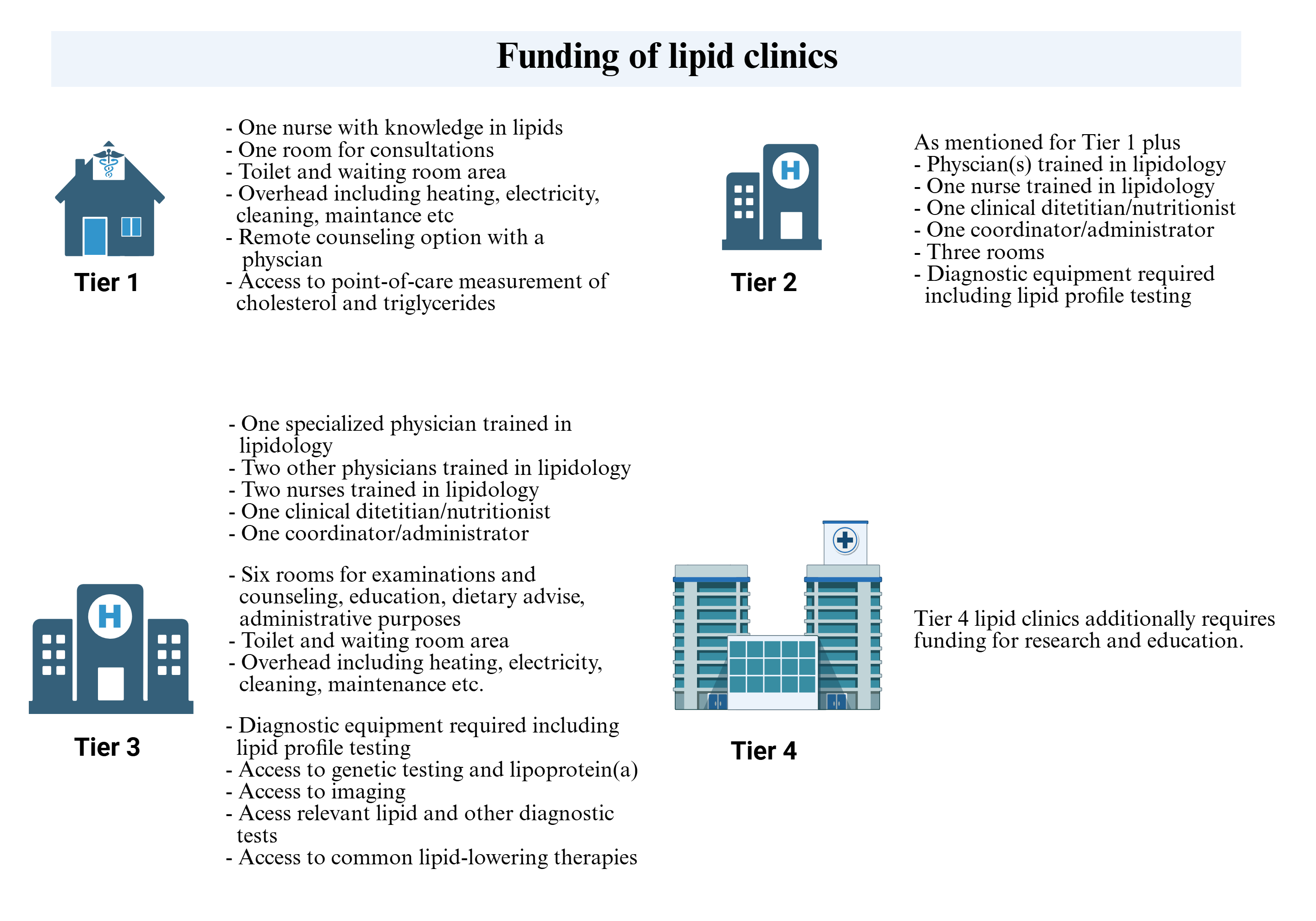
To achieve sufficient prevention of ASCVD, acute pancreatitis and other lipid-related diseases at national or regional levels, centralized funding of lipid clinics is of paramount importance. Otherwise, optimal prevention will only occur if single enthusiastic medical specialists happen to be employed at a given centre. Here we delineate the ideal funding framework for tier 1-4 lipid clinics in each country or region (Figure 12), essential for securing long-term reduction in ASCVD, acute pancreatitis and other lipid-related diseases. That said, the strategy may vary by country’s health services structure and complexity. Investment in lipid clinics should be viewed as a cost-effective strategy in the medium and long term.
Budget
Minimal budget to run well-functioning tier 1-4 lipid clinic (see Figure 4 and 6) will entail the expenses as shown in Figure 12. Tier 1-4 lipid clinics can be open from 1 to 5 days weekly, depending on the number of patients referred. Time allowed for duration of consultations for newly referred patients should be 45-60 min and for revisits 30 min.
Who funds lipid clinics?
Lipid clinics funding must be an integral part of any health care system, as lipid clinics represent an important part of health care and, thus, need to be included in the standards of care. National funding through government, complemented with local funding through regional governments, universities, and/or municipalities, all represent possible models.
Organization of lipid clinics will always be country/region specific and needs to reflect the general structure of the health care systems already in place. Therefore, providing a universal organizational scheme is difficult; however, above we describe essentials that can be taken as the basic principles of lipid clinic funding, elements that already have proven effective in several systems throughout Europe and elsewhere.
The proposed recommendations on budget for lipid clinic funding are based on expert opinions, guided by successful local implementation in several European countries.
Conclusions
The present EAS consensus paper provides guidance on how to harmonize and organize lipid clinics worldwide, with the long-term aim of preventing atherosclerotic cardiovascular disease, acute pancreatitis and other lipid-related diseases in individual countries. Lipid clinics are not cost drivers but a cost-containing infrastructure for ASCVD prevention. The main unmet need globally is no longer the development of additional guidelines, but rather the implementation of harmonized lipid clinic structures that allow existing guidelines to be effectively applied in clinical practice.
Following publication, a next phase will be to implement the advice given in different countries in Europe and in the rest of the world. The European Atherosclerosis Society will work in the future to secure such implementation. This will include international and national webinars in local language in all countries belonging the EAS Lipid Clinic Network, to disseminate the information given in this consensus paper.
In addition, EAS plans preceptorship courses in selected countries in Europe and beyond, designed to train key opinion leaders involved in running lipid clinics. These courses will focus on strengthening clinical practice and supporting the improvement and harmonization of lipid clinics within individual countries. Preceptorship courses include teaching delivered by physicians and other health care professionals from well-established lipid clinics, alongside structured visits to these lipid clinics and laboratories that provide lipid tests and other diagnostic modalities essential to lipid clinic practice.
Key performance indicators and quality assurance metrics for the success of such teaching initiatives will include increase in number of lipid clinics in individual countries over a five-to-ten-year period. In addition, yearly monitoring in lipid clinics should include number of patients diagnosed, percentage genetically tested, percentage with lipoprotein(a) testing, percentage of first-degree relatives offered diagnostic evaluation, percentage receiving lipid-lowering therapies and the percentage achieving their LDL cholesterol target goal. Such quality assurance metrics has successfully been used nationwide in Denmark since 2020.
Thank you to the authors
Writing group: Christian Bork, Børge G Nordestgaard, Berit Storgaard Hedegaard, Michal Vrablik, Elsie Evans, Tomas Freiberger, Zlatko Fras, David Nanchen, Fouzia Sadiq and Philippe Moulin.
EAS Lipid Clinic Network Committee: Børge G Nordestgaard (chair), Kausik K Ray, Kirsten B. Holven, Jeanine E. Roeters van Lennep, Ulrich Laufs.
Acknowledgement
This consensus statement is part of the EAS Lipid Clinic Network project to optimize the organization of lipid clinics within the network. EAS has independently managed all aspects of this initiative. The Society gratefully acknowledges the financial support in the form of unrestricted educational grants provided to the Lipid Clinic Network by Amgen, MSD, Novartis, Sanofi, and Viatris. These companies were not present at the Consensus Panel meeting, had no role in the design or content of the consensus statement, and had no right to approve or disapprove of the final document. Also, we thank Alex Lyons for preparing summaries of meeting discussions. Finally, we express our thanks to Alberico L. Catapano for his huge contribution in establishing the EAS Lipid Clinic Network and for running it from initiation until 2024.